Event Review: Asia University's Department of Digital Media Design Uses Toy Design to Introduce SDGs × SEL and Promote Creative Literacy Education
The Department of Digital Media Design at Asia University held the design thinking workshop “Toys Continuing: Design Thinking Workshop” (「從玩具有續-設計思考工作坊」) on the afternoon of November 12, 2025, in Room A407 of the College of Creative Design, as a key project of the Industry Co-Teaching (業師協同教學) course. The event integrates elements of the Sustainable Development Goals (SDGs, Sustainable Development Goals) and Social Emotional Learning (SEL, Social Emotional Learning), and through cross-school and industry collaboration, guides first-year students to rediscover creativity, culture, and emotional connection through toys.
The workshop invited designers Mei Jun-jie (梅君婕) and Cheng Dong-yi (程東奕) from Yin Guan Co., Ltd. (寅冠有限公司) as co-teaching industry mentors. The team hopes students will learn to observe, collaborate, and reflect while exploring toy design, and understand the creative industry from a more open perspective. The course began with “The Origins of Toys and Pop Culture.” Designer Cheng Dong-yi used examples such as Nara Yoshitomo (奈良美智)'s “Sleepless Night Doll (失眠夜娃娃),” KAWS's “Companion,” and the collaborative figurine by Hong Kong designer Eric So and Chen Guan-xi (陳冠希) to explain how toys combine artistic style, brand stories, materials and craftsmanship, and cultural symbolism. Assistant Professor Cheng Dong-yi noted that art toys have shifted from children's products to important creative commodities in the global collectibles market, helping students rediscover the cultural and commercial value of toys.
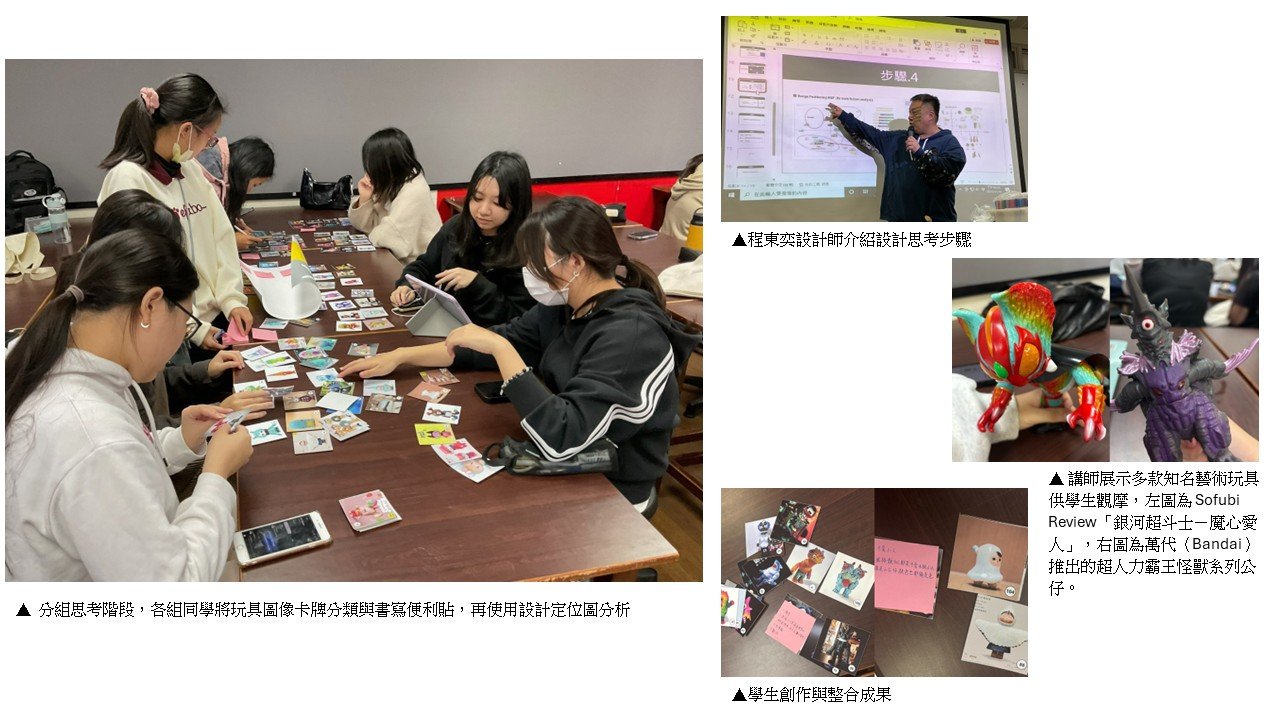
Entering the hands-on stage, the organizers distributed playing cards featuring character images from several well-known toy brands. Students selected characters that left a strong impression, observed their shape features, color schemes, and emotional expression, and visualized their observations with sticky notes. The activity helped students practice visual thinking and, through sharing and discussion, cultivated SEL skills in emotional awareness and expression. Students then used a “Design Positioning Map” for four-quadrant analysis, comparing characters along the axes of “simple–complex” form and “ordinary–beautiful” appearance, to understand the core logic of formal vocabulary and product positioning. Co-teaching mentor Designer Mei Jun-jie also circulated among the groups, offering professional advice and guiding students to integrate their perspectives.
Assistant Professor Li Xin-zhu (李心主) of the Department of Digital Media Design said: “This workshop not only helped students understand the cultural context behind toy design, but also naturally integrated SDGs sustainability thinking and SEL social emotional learning into the course. Through observation, discussion, and collaboration, students developed core skills such as empathy, critical thinking, and creative expression during hands-on practice. We look forward to building a more comprehensive foundation of design literacy for first-year students through cross-school and industry collaboration.”
Students responded enthusiastically, and many said the event gave them fresh insight into toy design.
First-year Department of Digital Media Design student Cao Yu-ru (曹鈺娸) said: “I originally thought toys were just cute in shape, but in class I discovered that the stories, emotions, and culture behind toys are very profound. Through character analysis and four-quadrant positioning, I better understood my own design preferences and learned how to organize visual elements. Most importantly, we shared ideas during group discussions, and collaborating was a lot of fun. It was a truly rewarding experience.”
Through this workshop, students experienced the design thinking process first-hand in a relaxed and interactive atmosphere. This deepened their understanding of toy culture and formal language, while also cultivating cross-disciplinary collaboration and emotional expression skills. The course reflects Asia University's educational strengths: promoting industry–academia cooperation, emphasizing sustainability and emotional education, and nurturing future creative talent through a professional orientation.
The workshop invited designers Mei Jun-jie (梅君婕) and Cheng Dong-yi (程東奕) from Yin Guan Co., Ltd. (寅冠有限公司) as co-teaching industry mentors. The team hopes students will learn to observe, collaborate, and reflect while exploring toy design, and understand the creative industry from a more open perspective. The course began with “The Origins of Toys and Pop Culture.” Designer Cheng Dong-yi used examples such as Nara Yoshitomo (奈良美智)'s “Sleepless Night Doll (失眠夜娃娃),” KAWS's “Companion,” and the collaborative figurine by Hong Kong designer Eric So and Chen Guan-xi (陳冠希) to explain how toys combine artistic style, brand stories, materials and craftsmanship, and cultural symbolism. Assistant Professor Cheng Dong-yi noted that art toys have shifted from children's products to important creative commodities in the global collectibles market, helping students rediscover the cultural and commercial value of toys.
Entering the hands-on stage, the organizers distributed playing cards featuring character images from several well-known toy brands. Students selected characters that left a strong impression, observed their shape features, color schemes, and emotional expression, and visualized their observations with sticky notes. The activity helped students practice visual thinking and, through sharing and discussion, cultivated SEL skills in emotional awareness and expression. Students then used a “Design Positioning Map” for four-quadrant analysis, comparing characters along the axes of “simple–complex” form and “ordinary–beautiful” appearance, to understand the core logic of formal vocabulary and product positioning. Co-teaching mentor Designer Mei Jun-jie also circulated among the groups, offering professional advice and guiding students to integrate their perspectives.
Assistant Professor Li Xin-zhu (李心主) of the Department of Digital Media Design said: “This workshop not only helped students understand the cultural context behind toy design, but also naturally integrated SDGs sustainability thinking and SEL social emotional learning into the course. Through observation, discussion, and collaboration, students developed core skills such as empathy, critical thinking, and creative expression during hands-on practice. We look forward to building a more comprehensive foundation of design literacy for first-year students through cross-school and industry collaboration.”
Students responded enthusiastically, and many said the event gave them fresh insight into toy design.
First-year Department of Digital Media Design student Cao Yu-ru (曹鈺娸) said: “I originally thought toys were just cute in shape, but in class I discovered that the stories, emotions, and culture behind toys are very profound. Through character analysis and four-quadrant positioning, I better understood my own design preferences and learned how to organize visual elements. Most importantly, we shared ideas during group discussions, and collaborating was a lot of fun. It was a truly rewarding experience.”
Through this workshop, students experienced the design thinking process first-hand in a relaxed and interactive atmosphere. This deepened their understanding of toy culture and formal language, while also cultivating cross-disciplinary collaboration and emotional expression skills. The course reflects Asia University's educational strengths: promoting industry–academia cooperation, emphasizing sustainability and emotional education, and nurturing future creative talent through a professional orientation.